
Accessibility Innovations and Emerging Technologies Research Lab
Accessibility by Design. Access for All.
Hello, and welcome to the AI+ET Research Lab website. We support faculty and students with making their courses fully accessible. We follow the principles of UDL and employ the three pillars of accessibility in teaching — design & pedagogy, materials & resources, and instruction & student experience. Our mantra is Accessibility by Design where we think of accessibilility as built-in at the design stage, rather than as an add-on or a checkmark. This part of our research work falls under the larger umbrella of Access for all.
Visiting?
If you want to visit the lab or if you are looking for help with accessiblising a course, please .
A few useful links: WCAG 2 Overview | ADA
Below, you will find details on some of our projects. Some are just starting out and more information will be available soon.
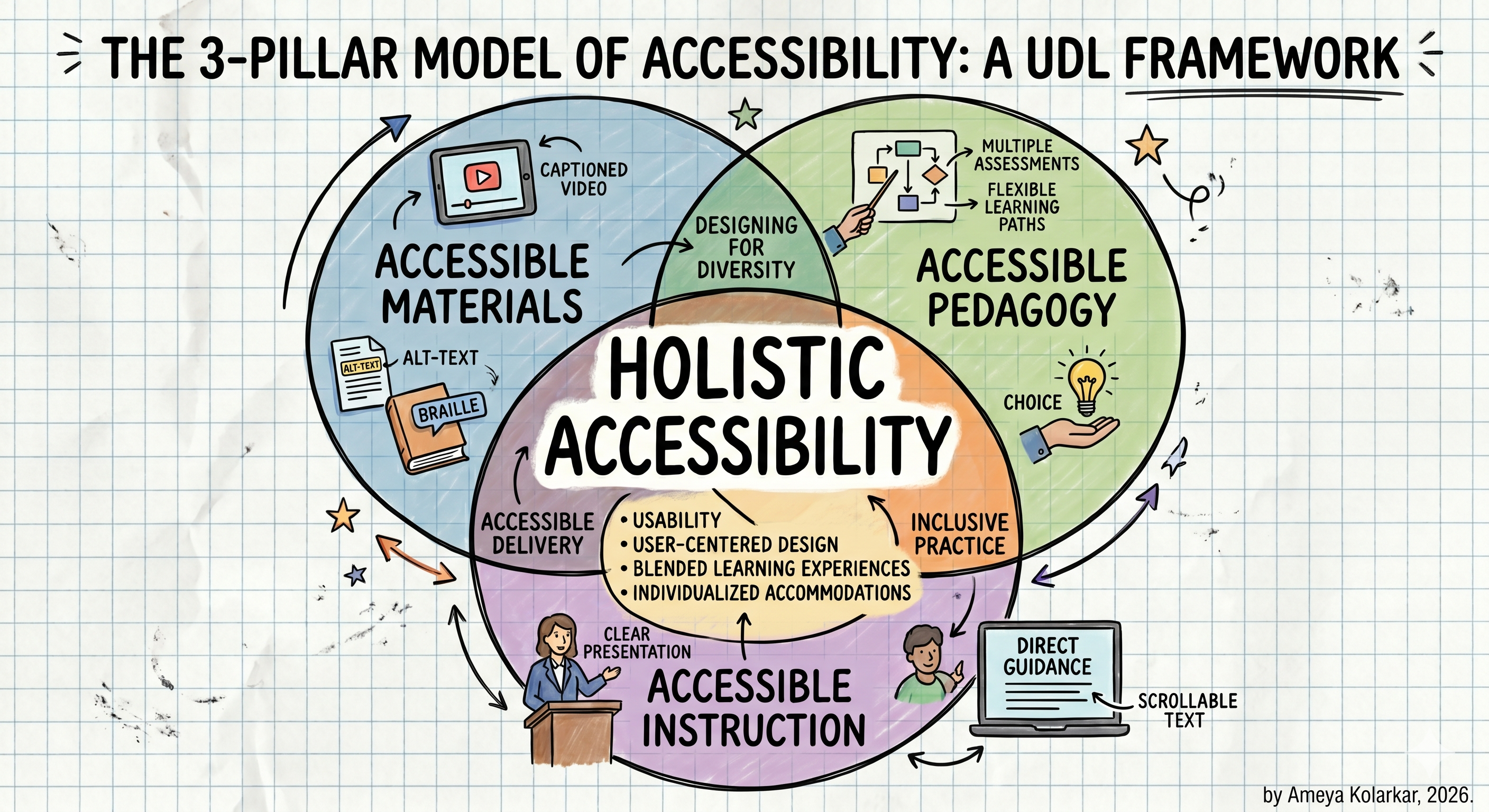
(Image description) A 3-circle Venn diagram that shows the three pillars of true accessibility in education: materials (resources), pedagogy (design) and instruction (student experience). The intersection of all three circles is where accessibility for all students lies. This image is generated by Gemini.
AI+ET Research Lab
The Accessibililty Innovations and Emerging Technologies Research Lab is focussed on generating and creating known strategies and novel innovations to help with making courses and other learning experiences accessible to all students, including students with disabilities. We are starting out with low-vision/blind students because that is how these projects (and Lab) started, and that is what we get most of our requests for. The Lab is currently physically located in DIF 102 on the main FSU campus.
Accessible Design and Pedagogy: From principles of backward design, we know to start at the "end," that is, with the goals of your course. Then we think about assessments to determine what constitutes evidence that your students have reached the goals, and finally think about and design activities that support learning towards that goal. This is a well-known iterative process but typically, faculty are not asked to think about accessibility. Are your Goals accessible and achievable for everyone? Do your assessments and activities work for everyone? We start the process out with the UDL framework as the foundation instead of thinking about it "when I have to."
Accessible Resources and Materials: This alludes to actual content matter — physical, tactile, digital. We take the UDL approach where we generate resources that can be translated to multiple outputs — pdf, html, braille, high contrast, etc. For example, for math and math-heavy courses, we write/code once in PreTeXt/PreFigure XML formats, and then output to any required format, including braille. We will (attempt to) create and generate 3D prints with braille, produce material for AR/VR glasses for audio immersion and descriptions, or for AI and AI wearables for interpreting information devoid of alternate forms that can be used by blind students.
Accessible Instruction and Student Experience: Once your course is properly designed and you have all the necessary materials, the implementation is equally important. We support faculty in evidence-inspired instructional practices for all students, as in, what not to say to students, how do deal with multimodality, using microphones (the "I don't need a mic" myth persists!), facilitating group work among diverse students, etc.
Standard Materials Production Process
Standard Production Process: There are situations where the process may differ; we evaluate every request with care. All productions are tested by our expert research assistants and amazing blind students.
-
Step 1: Initiation & Intake
Faculty identify a need for LVBS support (e.g., braille) and reach out to our team. They provide their existing notes and course materials. We offer support ranging from material conversion to full pedagogical instruction. Faculty with students with other disabilities are welcome to consult with us too.
-
Step 2: Conversion & UDL Review
We help convert the notes into accessible formats, for example, PreTeXt (text/equations) and PreFigure (images/diagrams) XML formats for math and math-heavy topics. (Note: LaTeX is easiest to convert). We concurrently evaluate the material for pedagogical soundness and Universal Design for Learning (UDL), consulting with faculty on any suggested changes.
-
Step 3: Tactile & Tech Enhancements
If the material benefits from 3D printing, tactiles (texture, audio), or emerging tech (AR/VR/AI), we develop these in concert with the faculty. If faculty time is limited, we may consult outside subject matter experts to ensure correctness.
-
Step 4: Delivery & Feedback
The finalized course elements are delivered* to the faculty. Physical creations (embossing, 3D prints) are produced via the OAS or Innovation Hub. We will provide pedagogical and/or instructional consultation if needed, and finally, request production feedback directly from the LVBS.
Courses Supported
- MGF 1130 Mathematical Thinking
- MGF 1140 Pre-calculus
- CHM 1045 Gen Chem I — partial support for now, 3D molecules only; notes coming soon
- New course (Spring 2026) "ArtScience" from Interdisciplinary Studies
- More math courses in the works.
We try to make it easy for the faculty — if faculty want to learn how to do the above, we will happily train them and/or anyone on their team.
Posters. Presentations. Media
Some pictures of students presenting their work as a poster at the Undergraduate Research Symposium on April 03, 2026 are below.
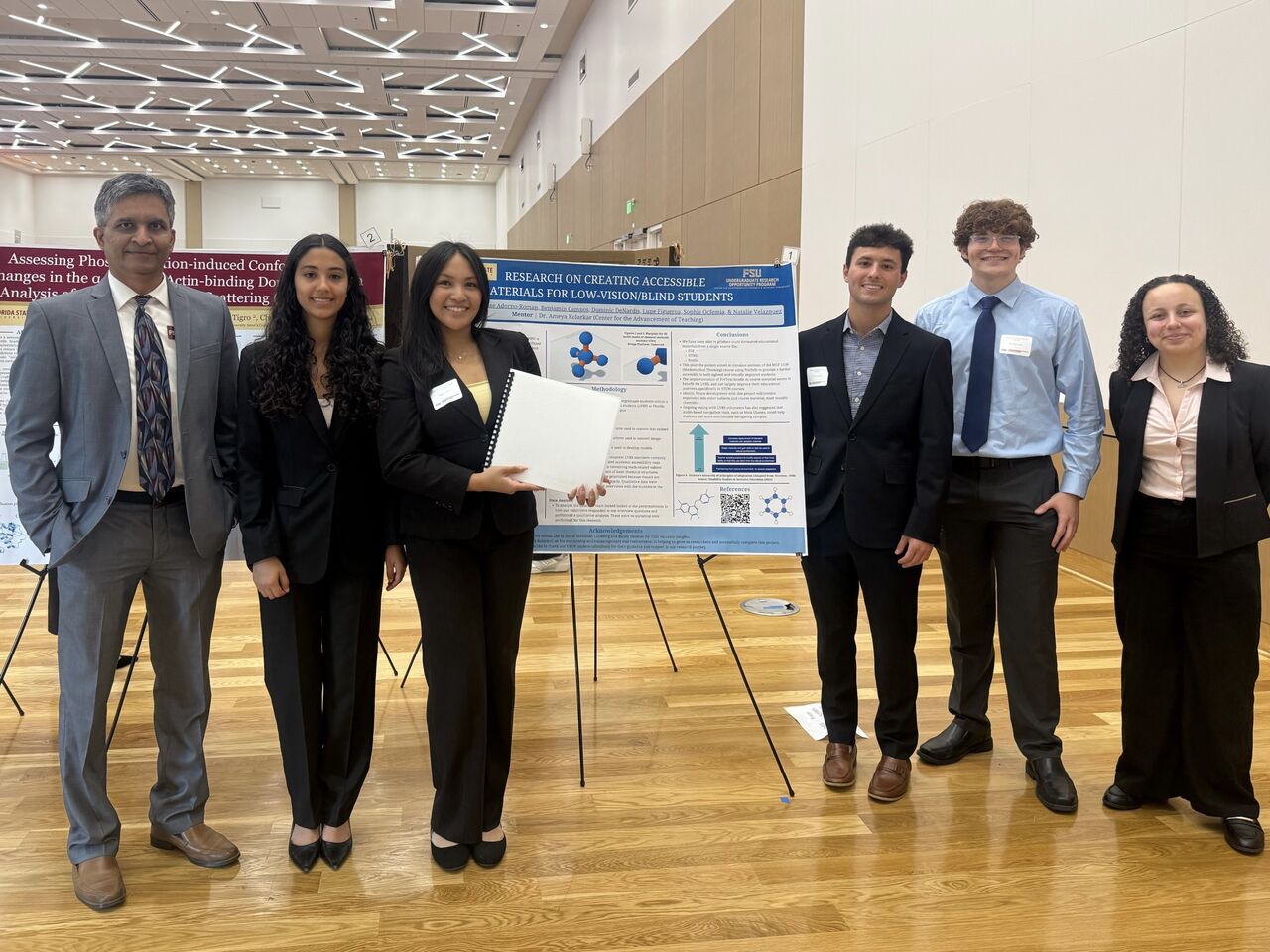
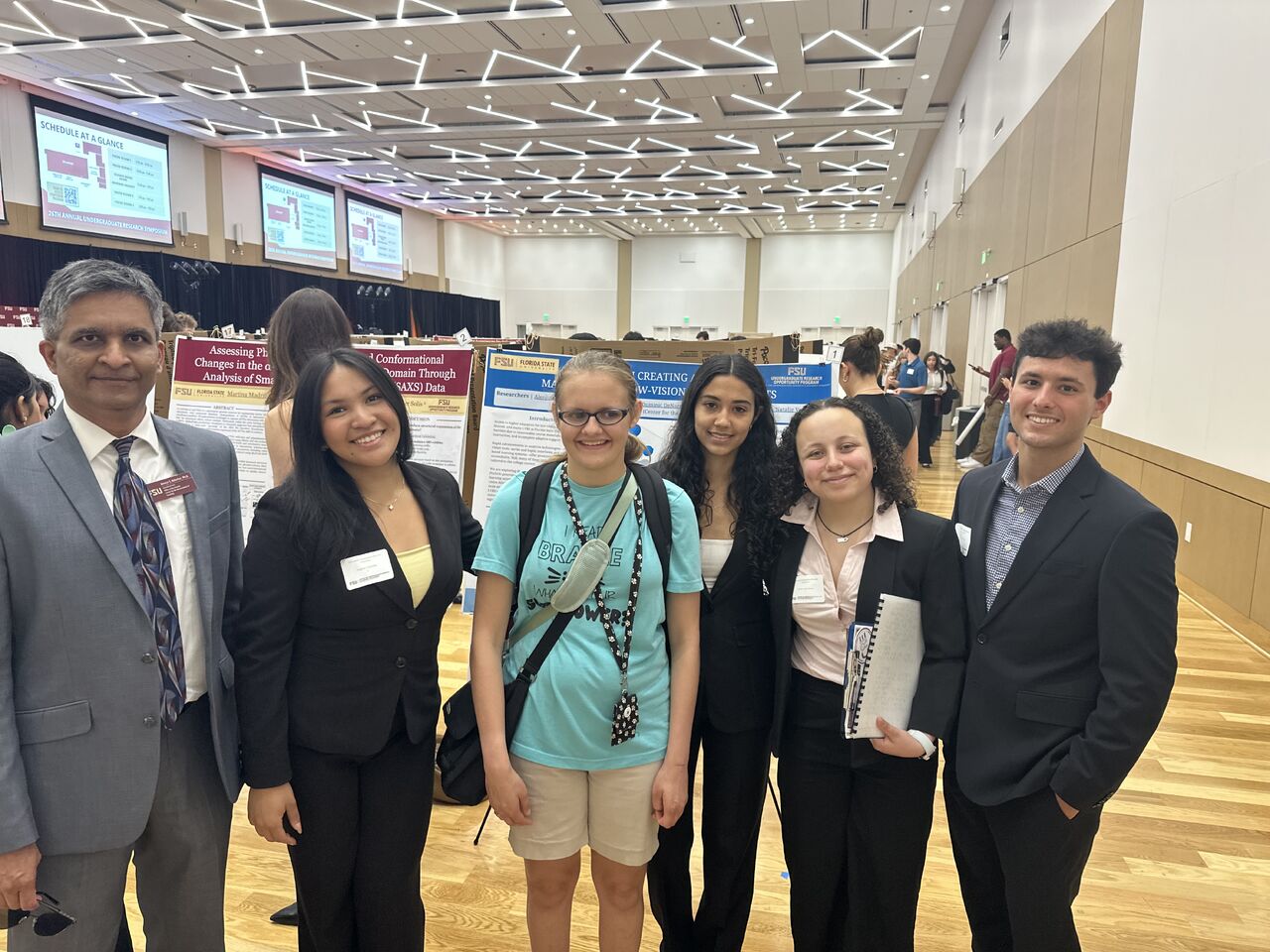
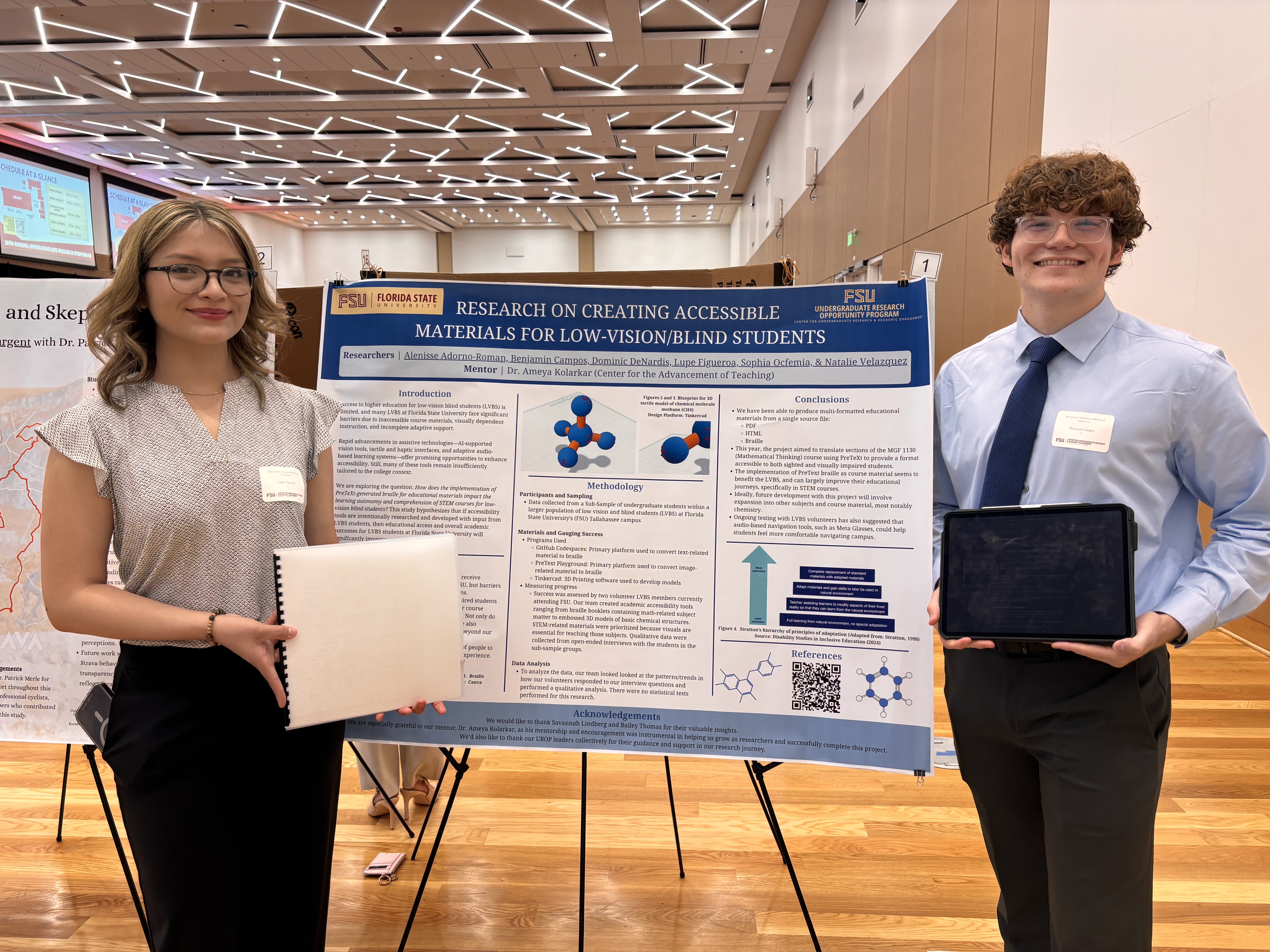
Here is the PowerPoint slide deck that I used at the invited, featured workshop at the CoTL 2026 Conference.
Emerging Tech Implementation Ideas
At AI+ET Research Lab, we also focus on newer technologies like AR/VR, AI, and their integration to find new, innovative solutions to existing issues. Although not all of these technologies are new, their combinations allow us to look for optimal solutions which these tech by themselves may not be able to achieve. Below are a few of our ideas.
We are currently testing the Meta AI glasses with our blind and deaf students. The use cases here are plenty: way-finding (crowdsourced, mapped using Unity/XR), audible and haptic interpretations of signage or written music for the blind, subtitles of spoken announcements for the deaf, AI-assisted quality-of-life improvements, entire movies, documentaries, planetarium shows interpreted (for the blind, deaf, neurodivergent, dyslexic, ...), and more.
Science experiments, engineering design and testing, etc. Several research and engineering labs around the US and the world are doing a great job making their labs accessible, including to blind students. This is beyond our capability as of now, but it is something we will persue when the time is right.
Safety. Independence. If a blind student or a person in a wheelchair needs help, how can we use context-aware technology to best assist them?
Study guide and coach with subject-level knowledge. E.g., explain a concept on a non-accessible page, allow for learning through "play" (for example, connect different "balls" (atoms) to different "sticks" (bonds): does this molecule exist or make sense? Why or why not?) Help with note-taking, or improving notes delivered to students so that note-taking becomes a non-issue.
Related Projects and Adventures
We have been approached by some other non-academic projects as well, for example, identifying issues (and suggesting/implementing solutions) at the Tallahassee Challenger Learning Center. There are more (a museum!), but we don't want to be spread too thin just yet.
Current and Past Student Researchers
Research Assistants:
- Bailey Thomas (reads/types braille, uses tactile materials, enjoys technology, has a seeing-eye dog named Sirius, past Learning Assistant) (2024-26)
- Savannah Lindberg (reads/types braille, uses tactile materials, enjoys technology, uses a cane, past student and current LA) (2025-26)
UROP Researchers:
- 2025-26: Alenisse Adorno-Roman, Benjamin Campos, Dominic Denardis, Lupe Figueroa, Sophia Ocfemia, Natalie Velazquez
Independent Researchers:
- 2025-26: Gracie Jean-Charles, Janiyah Outlaw
FAQs
How is this different than the services that the Office of Accessibility Services offers?
This is different. We support the entire course, including the pedagogy aspects and instruction. We work closely with the OAS, who produce our accessible material for the student and teacher. We also work with the technologies available at the Innovation Hub — 3D printing, Virtual and Augmented Realities (AR/VR), Artificial Intelligence (AI) and more — as necessary. STEM concepts and objects exist in three dimensions (e.g. molecules) and are dynamic (e.g. vibrations); we want to capture those elements that static pages do not (and cannot) provide.
What is your main goal?
Our main goal is to make the learning experience equitable for all our students. This means cultivating a mindset that accessibility in a course is "built-in" and not an afterthought or a checkbox. We work closely with faculty (who request our help or service) to make their material available to all students! Furthermore, we also train faculty on the pedagogical and instructional aspects of accessibility — simply having accessible materials is not enough. For this we follow principles of Universal Design for Learning (UDL) and Learner-Centered Teaching.
How much time does it take a project or course to complete transformation?
It depends on the complexity of the course, and your level of desired transformation. If a large number of 3D prints need to be made, that will take time. On the other hand, if all your notes are in, say, LaTeX, that will save time. It also depends on the number of students working in the lab at any given time, and the subject-matter expertise available. Please contact us to get a time estimate.
We are grateful for the support of all our campus partners. These include the ITS, OAS, Libraries, Classroom Support, Visual Disabilities Center, the Innovation Hub, and the faculty who work with us. Many thanks to our UROP researchers and our blind students (our expert consultants) for their passion and initiative towards this important work.
